PR Agency Press Release Templates For SEO 2026
Why PR agencies must rethink press releases for SEO in 2026
Press releases remain a high-ROI tool for PR agencies, but the rules have changed. Search engines now reward relevance, structured data, multimedia, and credible backlinks more than bulk distribution. For organizations seeking coverage and discoverability, a press release crafted with modern SEO in mind can drive organic traffic, authoritative links, and measurable conversions — not just newsroom picks.
This guide gives PR agencies ready-to-use press release templates and the SEO playbook for 2026, including headline formulas, metadata, multimedia strategies, distribution considerations, and tracking tactics.
What search engines and journalists expect now
- Relevance over volume: Google and news aggregators prioritize intent-matching content. A highly targeted release tailored to niche beats performs better than generalized blasts.
- Structured data and rich snippets: Implementing schema (NewsArticle, Organization, ImageObject) improves eligibility for rich results and increases click-through rates.
- Multimedia and accessibility: Video, images, captions, and transcripts boost engagement and indexing. See best practices on adding multimedia in press releases in this detailed resource.
Quick SEO checklist for PR agency press releases
- Optimized headline with target keyword (short, clear, and under 80 characters).
- Strong subheadline that includes variations and entities.
- First paragraph answers: who, what, when, where, why, how — include the primary keyword early.
- Use 400–800 words for newsworthy releases; longer pieces for thought leadership (800–1200 words) with clear sections.
- Include 2–3 relevant links: one to a landing page, one to a resource or study, and one to allow journalists access to assets.
- Add schema.org markup for NewsArticle and Organization.
- Attach multimedia with alt text and transcripts.
- Use canonical tags and a media kit URL.
(For a deeper distribution-focused checklist, review an advanced distribution and SEO guide.)
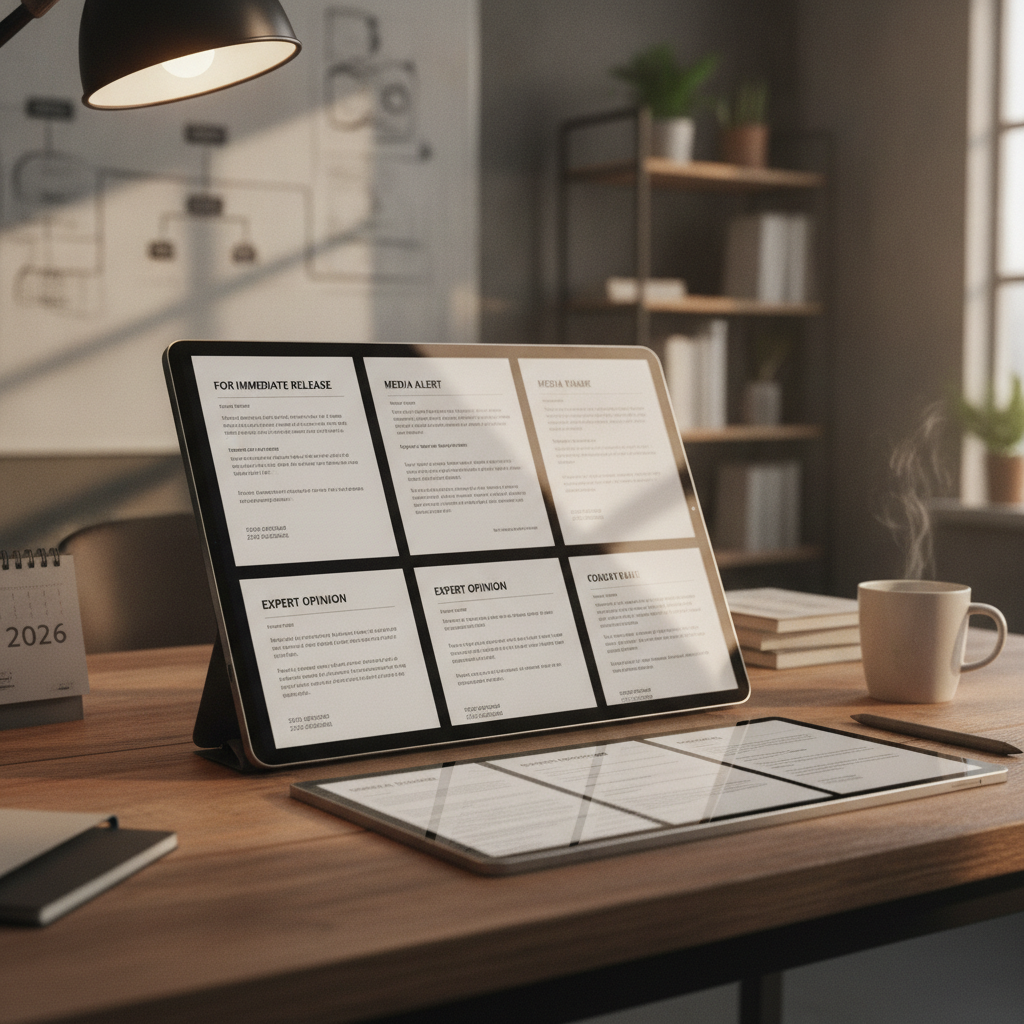
Template A — Product launch (SEO-optimized)
Purpose: Announce a new product or feature and capture search queries from prospective buyers.
[City], [Date] — [Company Name] today announced the launch of [Product Name], a [short product descriptor that includes the main keyword and primary benefit]. The new [product/service] helps [target audience] to [primary benefit], reducing [pain point] by [quantified result].
Key details
- Product: [Product Name]
- Availability: [date / regions]
- Pricing: [basic pricing info or call-to-action]
Quote
“[Short, newsworthy quote that adds credibility and uses brand/keyword],” said [Name, Title], [Company].
Supporting context (second paragraph)
Explain market context, brief competitor positioning, and link to a case study or landing page. Include one internal link to the product landing page and one to a related resource.
Boilerplate
[Two-line company description: who you are, what you do, website link, and one-sentence mission statement.]
Media contact
[Name]
[Title]
[Email]
[Phone]
SEO notes for Template A
- Headline: include the product name + primary keyword (e.g., “[Product Name] Launches to Help [Primary Keyword]”).
- Meta title & meta description: craft separate fields for CMS with focused keywords.
- Schema: NewsArticle with mainEntityOfPage pointing to the press release URL.
Template B — Expert commentary / thought leadership
Purpose: Position your client or executive as an industry authority while targeting topical keywords.
[City], [Date] — As [industry trend] reshapes [sector], [Executive Name], [Title] at [Company], offers data-backed insights and an actionable framework for [target audience].
Lead paragraph with data or a bold stat. Mention the keyword naturally.
Top three takeaways
- Insight one — explanation and tactical step.
- Insight two — include a short example or micro case study.
- Insight three — a forward-looking prediction.
Quote and research
Include a quote and reference to a report or internal data. Link to the whitepaper or downloadable resource.
Boilerplate and contact details
Same format as Template A.
SEO notes for Template B
- Use H2/H3 in the body (in CMS) to structure longer content — helps featured snippet potential.
- Link to high-authority sources and relevant in-house assets.
Template C — Crisis update / important notice
Purpose: Communicate fast, clearly, and with SEO-friendly clarity during an incident.
[City], [Date] — [Company] provides the following update regarding [issue]. Our priority is [safety/continuity]. Here are the facts and actions being taken.
Key facts
- Fact 1: concise statement.
- Fact 2: timeline and next steps.
- Fact 3: resource links (support, FAQs).
Contact for media
Provide dedicated hotline, email, and spokespeople credentials.
SEO notes for Template C
- Use simple, factual headline that includes the incident type.
- Publish to a stable URL and update the release rather than creating multiple separate posts.
- Implement 301s if content is moved and keep canonical consistent.
Distribution strategies that matter in 2026
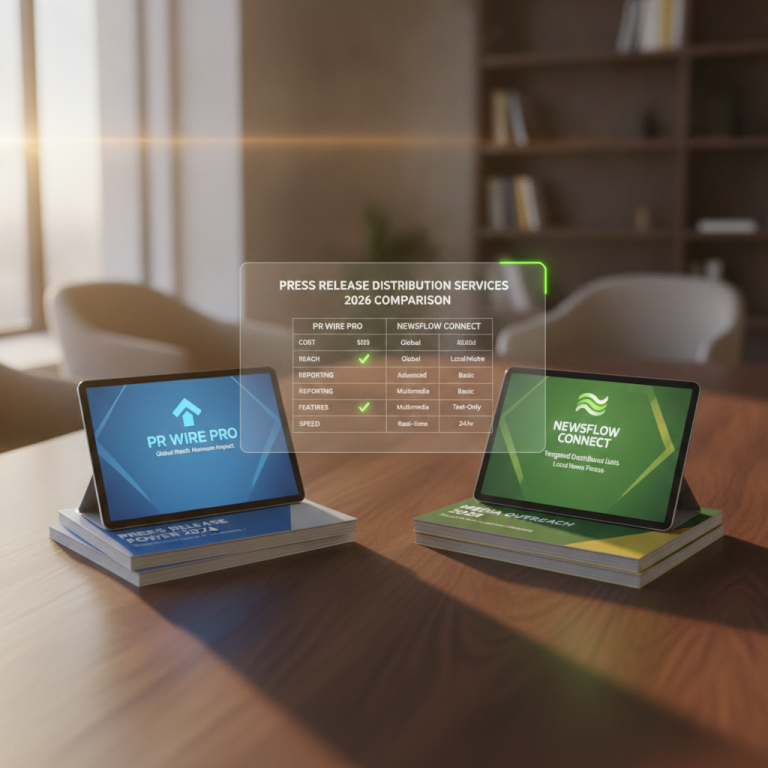
- Targeted newswires vs. hyper-targeted lists: Balance broad wire distribution for reach with targeted media lists for domain authority and better link opportunities.
- Multimedia packages: Send a media kit with images, video, and a short b-roll. Multimedia increases pick-up and social engagement; learn more about multimedia best practices here.
- Repurposing: Convert press releases into blog posts, social threads, or LinkedIn articles to amplify signals and capture varied search intents. See creative ways to repurpose press release content.
- Partnerships and co-pitches: Collaborate with industry partners for joint releases to expand backlinks and credibility.
For distribution trends and strategy alignments, review current analysis on distribution trends 2026 for actionable ideas.
Linking, backlinks and credibility
- Natural editorial links: Aim for journalist pick-ups that link back to your client’s site or the press release host. These editorial links carry more SEO weight than links embedded in a distribution wire.
- Nofollow vs dofollow: Most wire services use nofollow, but journalist articles and trade outlets often provide dofollow links. Track which outlets produce dofollow coverage and prioritize them in outreach.
- Anchor text: Use natural anchor text in surrounding content and avoid over-optimization.
For tactical outreach and growth-focused distribution tactics, explore PR agency growth hacks that scale reach while preserving link quality.
Measuring success: KPIs for PR + SEO
- Organic traffic to the release page and linked landing pages.
- Number and quality of backlinks (domain authority of pickup sites).
- Referral traffic from media placements.
- New leads or conversions attributable to the release (UTM tracking and landing page forms).
- Engagement metrics on multimedia (views, plays, time on page).
Set baseline metrics before distribution and measure 30/90-day impact.
Technical and accessibility best practices
- Use descriptive image filenames and alt text — both help image search and accessibility.
- Provide transcripts for videos and captions for audio.
- Ensure press release pages are indexable, have fast load times, and mobile-first formatting.
- Implement structured data (NewsArticle, VideoObject) to improve visibility in SERPs.
Repurposing and lifecycle management
Turn each press release into a content hub: a long-form blog, a social series, a podcast snippet, and a data visual. Repurposing not only amplifies reach but also creates more internal linking opportunities and content for targeted keywords — see eight creative repurposing ideas here.
Final checklist for PR agencies before pressing publish
- Headline and subheadline optimized for search and clarity.
- Primary keyword in the first 100 words.
- Two to three strategic links and UTM parameters for tracking.
- Multimedia attached with captions and transcript.
- Schema markup added and validated.
- Media contacts and boilerplate completed.
- Distribution strategy mapped: list of outlets, wire services, social rollout, and follow-up outreach.
Press releases remain a staple of PR agency toolkits in 2026, but success requires combining newsroom craft with SEO rigor. Use the templates above as starting points, pair them with multimedia and structured data, and track outcomes to refine your approach.
End with action: align your next release to a measurable objective, map distribution to high-value outlets, and iterate using the metrics above to build long-term visibility and authority.