
Timing Press Releases Across APAC: A Singapore PR Guide
A Singapore technology firm schedules its biggest product announcement of the year for 9am local time, confident the wording is sharp and the embargo list is clean. By the time it lands, Jakarta has been awake and scrolling for two hours, Sydney is already at lunch, and most of San Francisco is still asleep. The release reads well everywhere. It simply does not arrive at the same moment in anyone’s news day, and for a region this spread out, that gap can be the difference between a story a journalist opens straight away and one that sinks to the bottom of an inbox.
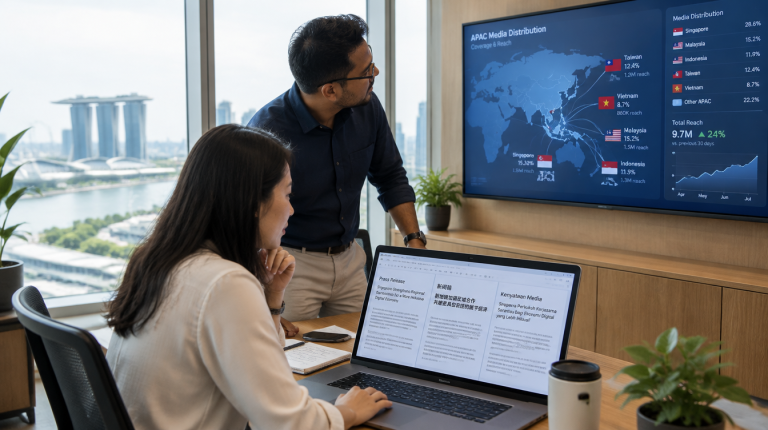
Press release writing and distribution advice usually assumes a single clock, but press release timing across Asia Pacific has to assume several at once. A firm distributing from Singapore across Southeast Asia, Greater China and Australia is really publishing into half a dozen separate news days at once, each with its own morning rush, its own quiet stretch, and its own public holidays. Getting the words right is only half the job. Getting the moment right is a separate skill, and it is one most Singapore PR teams plan for only after a launch lands badly.
A Region Split Across Six Time Zones
Singapore sits at UTC+8, alongside Manila, Hong Kong and most of mainland China, but Jakarta and Bangkok run an hour behind, Hanoi is on the same clock as Bangkok, and Sydney and Tokyo run one to three hours ahead depending on the season. A press release timed for a Singapore morning can land well before office hours in Jakarta and well after the working day has ended in Sydney. None of this is a reason to avoid regional distribution. It is a reason to stop treating “9am” as a single instruction and start treating it as a question with six or seven different answers.
When Different Markets Actually Read the News
Regional research gives some shape to those answers. A Blackbox Research study of more than 9,000 respondents across Singapore, Malaysia, the Philippines, Thailand, Vietnam and Indonesia found that a third of Southeast Asian news consumers start reading before 9am, while almost as many do not start until after 6pm in the evening. The split is not even across markets either.
Singaporeans lean early, with 42% starting their news day before 9am and a clear preference for hard news over soft stories. The Philippines runs the opposite way, with 52% of readers waiting until after 6pm to start consuming news, favouring softer, more human stories earlier in the day. A single release timed to catch one of these audiences at their most attentive moment can just as easily miss the other entirely, which is part of why a press release built for Singapore eyes alone, discussed in our guide to localising press releases for APAC, rarely performs the same way once it crosses a border.
Five Timing Patterns to Build Into the Calendar
None of this needs to turn into a spreadsheet nobody maintains. A short, shared checklist tends to catch most of the real problems before they reach a journalist’s inbox.
- Map each target market’s working hours against Singapore time before setting a release slot, instead of assuming the Singapore clock travels well.
- Flag lunar and religious holidays separately from fixed public holidays, since Lunar New Year, Ramadan and Diwali shift every year and can quietly swallow a week of regional coverage.
- Check each market’s typical news day shape, since an early-reading audience and a late-reading one rarely respond to the same release slot.
- Build a buffer around major regional events, such as a neighbouring country’s election week or a widely watched sporting fixture, when newsroom attention shifts elsewhere.
- Keep a running calendar of past release times and their pickup, by market, so the next decision is based on what actually happened rather than a guess repeated from the last campaign.
Coordinating Teams Without the Midnight Calls
The timing problem is not only about readers. It also sits inside the team preparing the release. TEAM LEWIS Asia has described time zone differences as a kind of silent friction in global coordination, one that slows decisions and strains project work long before a single word reaches a journalist. Its suggested fix leans on asynchronous collaboration tools so reviewers in different markets can weigh in on their own schedule, with any meeting that genuinely cannot wait rotated around the region so the inconvenient slot moves instead of always falling on the same office.
Staggered or Simultaneous: Matching Release Pattern to the News
Some announcements genuinely need to land everywhere at once. Financial disclosures, regulatory updates and anything a listed company is obliged to release under continuous disclosure rules should go out simultaneously across every market where it is price sensitive, since staggering that kind of news can create exactly the selective disclosure problem the rules exist to prevent. Singapore-listed issuers in particular should treat this as a compliance question first and a timing question second, and should check their own obligations with SGX or a compliance adviser instead of relying on general guidance like this.
Feature stories, product launches and most corporate news carry no such obligation, which leaves more room to stagger. Releasing into Singapore and Hong Kong first, then following a few hours later in Jakarta, Bangkok and Manila once those markets are properly awake, often earns a cleaner first wave of coverage in each location than trying to catch every newsroom in one global blast. The right pattern depends on the story, not a fixed house rule.
Turning This Into a Habit, Not a One-Off Fix
A single well-timed release fixes nothing on its own. The teams that consistently land coverage across APAC tend to be the ones running a living release calendar, one that tracks each market’s holidays, typical reading windows and past pickup alongside the release schedule itself, reviewed every few months and never left to sit untouched.
None of this replaces a strong story or a well-written release. It simply gives that story the best chance of reaching a journalist, and the reader behind them, at a moment when either is actually paying attention. For PR teams juggling several APAC markets from a Singapore base, that is usually the harder half of the job, and the one most often left to guesswork. If building that calendar feels like more than your team has time for, our team is happy to get in touch about it.